
Choosing the Right Model for Your Writing
When choosing a model for fiction, what matters most is the cadence and texture of its prose. General benchmarks and coding leaderboards tell you very little about storytelling ability—voice, pacing, dialogue authenticity, and respect for narrative formatting determine whether a passage truly belongs in your manuscript.
Download NovelThread — macOS & Windows · View download details
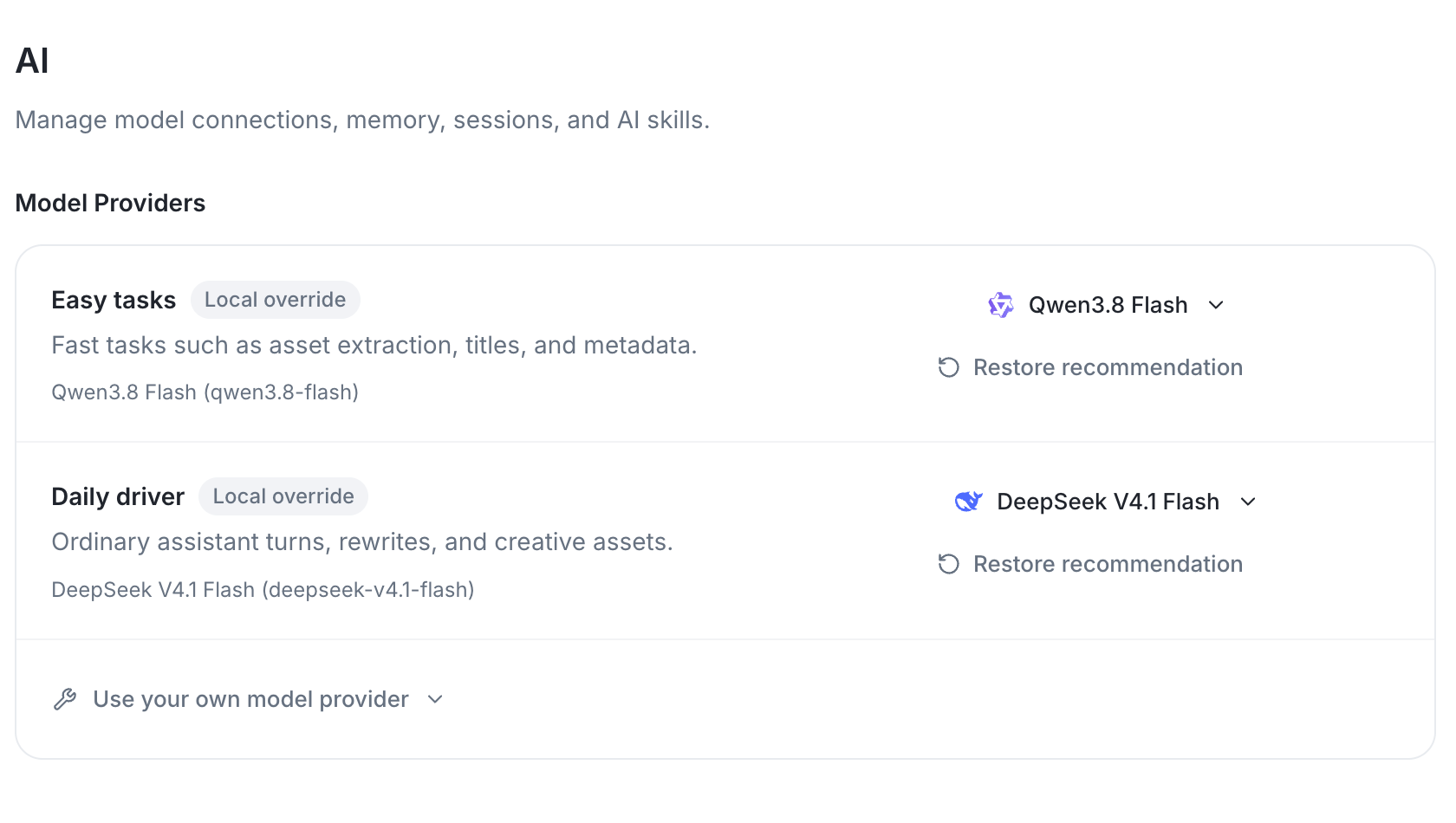
Compare models using your own prose
- Match the model to the task: drafting calls for voice, cadence, and vivid sensory detail; plot outlining demands cause-and-effect coherence; and story bible lookups require reliable recall and synthesis. Different models can excel at different parts of your creative process.
- Blind-test with the same scene: send the exact same excerpt, character traits, and scene instructions to two or three models. Read the results without looking at the model names, noting how much you would keep untouched and how much you feel compelled to rewrite. That is far more telling for a novelist than any benchmark score.
- Check language and formatting first: evaluate natural phrasing, appropriate register, consistent point-of-view, dialogue punctuation, and paragraph rhythm. Watch closely: when you ask for story prose only, does it stay in scene, or does it clutter the output with bullet points, headings, or chatty preamble?
- Check narrative integrity next: listen for distinct character voices, check whether emotional conflict feels earned, and ensure established world rules aren't broken or future plot reveals spoiled. Ask for a single local edit to see if the surrounding prose stays cleanly intact.
- Choose your Reasoning Effort strategically: the golden rule is that 'most novel drafting and prose polishing tasks do NOT need high reasoning (keep it on low, minimal, or default)'. Excessive reasoning adds dozens of seconds of latency and extra token costs, and often causes analytical exposition to bleed into the prose. Reserve High Reasoning exclusively for untangling intricate plot webs, mapping multi-volume foreshadowing, auditing timeline and worldbuilding contradictions, or unblocking deadlocked character motivations.
- Balance creative flow with response time: weigh waiting time, the usage multiplier shown in the menu, and the manual editing required. A model whose output requires minimal rewriting is the true time-and-money saver in long-form fiction. Use only the options available in the current model menu.
Model characteristics and suggestions
Based on official model specifications and fiction stress-testing feedback across the 13 supported core models. Suggested trials and notes are recommendations tailored for novelists rather than synthetic benchmarks; availability, versions, and usage multipliers follow your current App menu.
Scroll the table horizontally to see the full comparison.
| Model | Strengths and suggested trials | Things to watch for |
|---|---|---|
| Kimi K3Official source | Massive context capacity (million-token grade) and deep archival memory retrieval. Outstanding for Story Bible consistency verification, tracking cross-volume foreshadowing across hundreds of chapters, and evidence-grounded structural analysis. | Large context does not guarantee automatic focus on subtle micro-emotional shifts; processing entire manuscripts incurs noticeable latency and potential narrative drift. Feed compact premise summaries for tight scenes. |
| GLM 5.3Official source | Engineered for high-order causal reasoning and multi-threaded plotting. Ideal for macro outline construction across multi-faction conflicts, closing cause-and-effect loops, and diagnosing character motivation deadlocks. Excels with high reasoning as a narrative architect. | Deep reasoning steps introduce higher token costs and generation latency; best reserved for structural outlining and plotting audits rather than quick single-sentence polishes. |
| GLM 5.3 FlashOfficial source | High-throughput response speeds and strict format compliance. Highly effective as an agile co-pilot for drafting scene beats, brainstorming chapter titles, and executing tightly bounded paragraph rewrites under strict word limits. | Reasoning depth for sprawling multi-POV webs is more modest than the flagship; watch for scenes moving too quickly without enough sensory grounding. |
| Gemini 3.8 FlashOfficial source | Millisecond response speed paired with large context capacity, coupled with solid negative constraint adherence (demonstrating far greater restraint in benchmark stress tests than Gemini 4). Excellent for rapid draft skimming, multi-angle premise generation, and interactive drafting. | Narrative voice defaults to an orderly, objective tone; provide concrete prose samples when aiming for gritty vernacular or rich period flavor. |
| DeepSeek V4.1 FlashOfficial source | Outstanding narrative grounding, deep unvarnished prose texture, and zero stilted phrasing. Exceptional at grounded combat kinematics, physical weight and momentum, and causal outline auditing. Negligible marginal cost makes it the premier high-volume drafting benchmark. | In thinking/reasoning mode, monitor that analytical deductions do not bleed into fiction narration; for softer contemporary literary fiction, prompt for understatement to temper its natural hard-boiled cadence. |
| Qwen3.8 FlashOfficial source | Deep cultural and period grounding, lively dialogue, and colorful idioms. Especially strong at historical fiction, wuxia, fantasy combat, and vibrant colloquial dialogue between colorful characters. | Left unconstrained, it can over-indulge in decorative prose or symmetrical idioms; provide explicit negative constraints (e.g., 'concise prose, avoid purple adjectives') to maintain narrative pacing. |
| MiMo-V2.6-FlashOfficial source | Sub-second token latency and minimal resource footprint. Highly specialized for inline sentence completions, idiom replacement, and micro rhythm tuning without breaking author concentration. | A strictly micro-level polishing tool; lacks the reasoning depth for multi-chapter plot arcs or complex foreshadowing webs. |
| Hy3Official source | Nuanced context comprehension and balanced emotional transitions. Reliable at steady progression, interpersonal relationship dynamics, and grounded atmospheric scene building. | Prose register leans calm and even-tempered; inject distinct stylistic excerpts when aiming for high-stakes thriller tension or surrealist interior monologues. |
| GPT-6 LunaOfficial source | Fast, budget-friendly drafting. Well-suited for chapter titles, premise summaries, quick scene staging, and transforming rough outlines into actionable beat sheets. | May rush past subtle psychological subtext or reveal underlying motives prematurely; reserve layered relationship climaxes for higher-tier reasoning partners. |
| GPT-6 SolOfficial source | Flagship reasoning model for sprawling narratives, complex multi-faction political schemes, hard science fiction rulesets, and multi-perspective conflict choreography. | Higher latency and credit cost; best deployed as a consulting editor for climactic revelations, core mystery resolutions, and worldbuilding integrity checks. |
| Claude Opus 5.5Official source | The gold standard for literary aesthetic sensibility, subtext, and unspoken emotional tension. Captures human micro-expressions, glances, and devastating pauses with zero artificial sermonizing. | Premium generation time and credit multiplier; best reserved for pivotal relationship revelations, major dramatic climaxes, and final manuscript polish. |
| Claude Sonnet 5.5Official source | The premier all-around balance of prose texture, authentic character voice, and responsiveness. Fluid narrative pacing and exceptional instruction following make it the core workhorse for high-grade drafting. | Tends toward polished elegance; if you need unrefined dialect or intentional rough grit for specific characters, explicitly instruct it to preserve fragmented syntax. |
| Claude Haiku 5.5Official source | Master of literary restraint and agile minimalism. Industry-leading adherence to strict negative constraints (forbidden words, viewpoint boundaries, preserving secrets); exceptional at noir, deadpan irony, and sensory precision with near-zero revision overhead. | Large-scale battle choreography can lean impressionistic; provide concrete camera and blocking cues when staging complex mass-troop engagements. |
When a passage could go in different directions, use rewrite candidates and blind selection to compare alternatives before choosing one.